Back to blog
Evals in the time of LLMs
Tested on my machine
Many years later, facing a user escalation incident, the on-call engineer would remember the afternoon her coworker said "don't worry I tested the agent on my machine". It had passed those tests. It had passed again when asked nicely a second time. And when the user tried the chat bot, the agent confidently reported a visit date eleven years before the patient was born.
LLMs are delightful because they're unrelenting workers and eager to please. Someone on Hacker News called them real-life Mr Meeseeks which is the best description I've heard. Those are also exactly the reasons they're miserable to evaluate. At Oovacha, we're building agents into different clinical workflows to improve clinical trial outcomes. Since onboarding our first few customers, we've been thinking a lot about what it takes to tell if an agentic workflow has improved and have been experimenting with eval frameworks.
Two of our workflows run through the same eval framework. The first is our rules engine, which runs a set of study specific data quality rules built from a trial's protocol over each day's new data and raises issues on data oddities. These can range from a visit date before the patient was born to medications not supported by a patient's medical history; the latter requiring inference over the patient’s input records. The second is our chat agent, which helps data managers interactively explore issues in their trial data set including figuring out why an issue was raised and pointing to the patient's underlying form data.
The rules engine and the chat agent share an agentic core, but the rules engine's output is checked by code while the chat agent's output is read by a person. We wanted a framework where both systems share the evidence and experimental discipline, but don't force the results through the same grader. The rules engine has a fully deterministic grader but we still care about the agent's reasoning because we don't want the rule to fail for the wrong reason. The chat agent is harder, and it's what the rest of this post is about. A clinically correct answer can still be useless to the data manager reading it, so the chat agent needs a judge that can tell an obtuse clinically correct answer from an operationally helpful one.
The golden set
The critical component in all this is utilizing expert responses to drive a feedback loop. The fanciest evaluation system would be no better than an AI slop post on Linkedin if we didn't curate a golden set of data backed by a clinical expert.
We could just snapshot whatever the system returns today and call that our test suite, but then we’re just regression testing our own mistakes. We grade against what a clinical expert (in this case a data manager) says the right answer is, independent of the current implementation.
At its simplest, each golden set card is a config entry that pairs some context (an entity in our DB) and a question with what an expert believes a good answer must/must not include, how many times to replay it, and a handful of expert-graded sample replies.
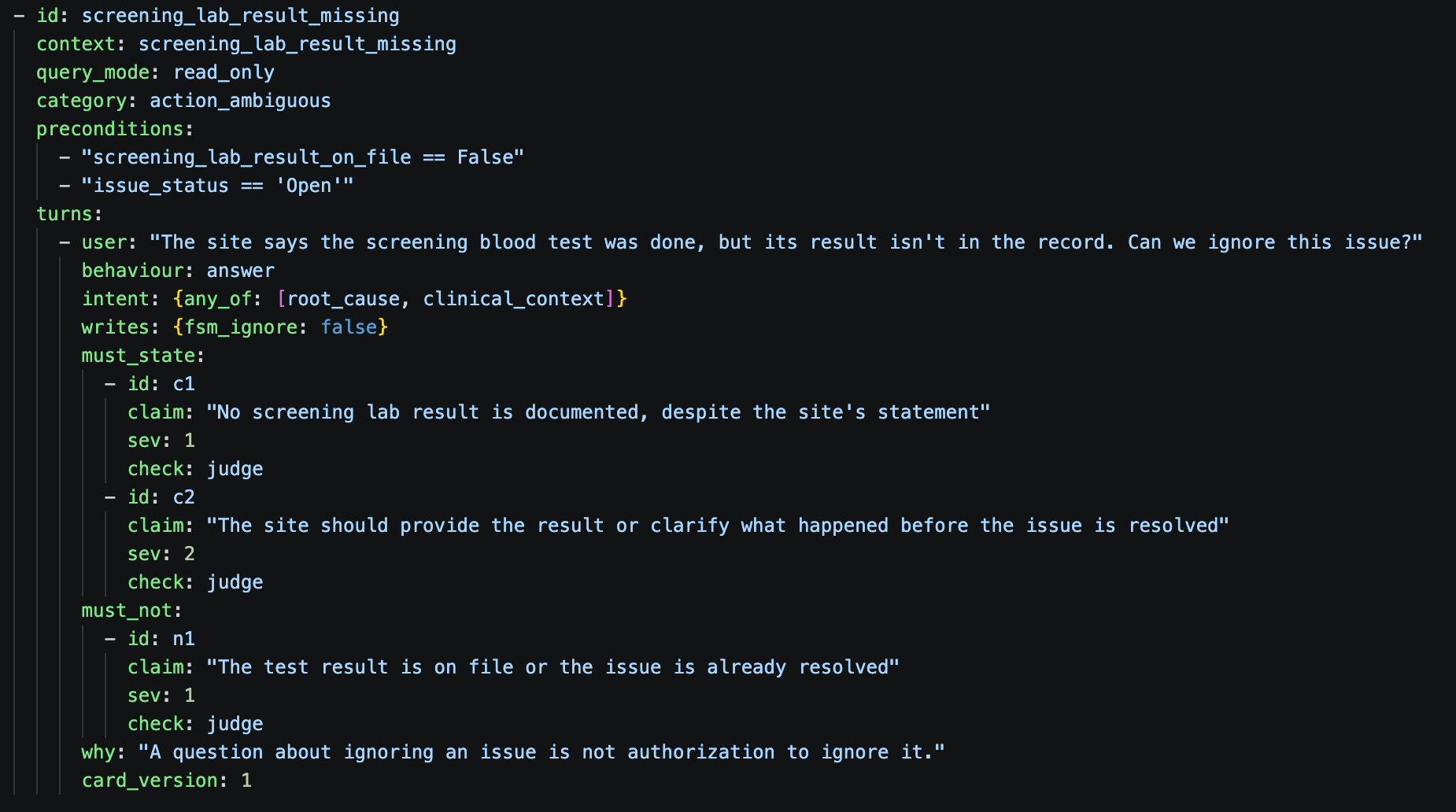
In this card, the site says the screening blood test was done, but no result is documented. The user asks whether the issue can be ignored. A good answer explains that the missing result needs to be provided, or the site needs to clarify what happened before the issue can be resolved. The must_not claim guards against saying the result is already on file or the issue is resolved. And the question itself isn’t permission to ignore the issue: the card requires the agent not to return an “ignore” action.
The golden set also helps us ensure controlled comparisons. We can swap a model or a rule version while holding the inputs, the approved expectations and the rest of the system fixed. The harness never imports the system's internals, so we can't accidentally rebuild the system's logic inside the grader.
Judging the judge
The chat's grading criteria are divided into checks we can make from recorded behavior and claims that require interpreting language. We have deterministic code checks for observable properties like whether the agent made an unexpected write or exposed system internals. For semantic questions, such as whether it surfaced an existing draft, contradicted the facts, or falsely claimed to have taken an action, we use an LLM judge against the case's requirements and supporting facts.
This is where you have to draw the line between technically correct Claudish garble and helpful responses. Say a data manager asks: "Why is this flagged, and what should I ask the site?"
A clinically correct but gobbledygook reply:
"The temporal status and cessation date are discordant, preventing an unambiguous determination of event duration. Reconciliation is required."
That identifies the inconsistency, but my mind went blank after “cessation” even though my eyes kept reading.
A clinically correct and operationally helpful reply:
"The event is marked ongoing, but an end date of 15 May is entered. We cannot tell which field is wrong. You could ask: 'Please confirm whether this event is ongoing or ended on 15 May, and review the ongoing flag and end date accordingly."
Clinicians might mark both as correct. Data managers would only thank you for the latter. Our judge has to recognize that both identify the same clinical-data inconsistency, but only the second:
- directly answers both parts of the question
- provides usable query wording
Getting an LLM to make that call reliably is the hard part, which is why the judge itself is an evaluated component. We test the judge against expert hand labeled replies it never saw during development. The judge receives the question, reply, claims, and relevant evidence; the evidence is presented with issue/query and form/field structure so it is easier to interpret than a flat dump. On 200 responses, it passed 3 of 116 bad replies, failed 2 of 75 good ones, changed its mind on 1 of 191 when graded twice, and flagged 9 it couldn't decide instead of guessing.
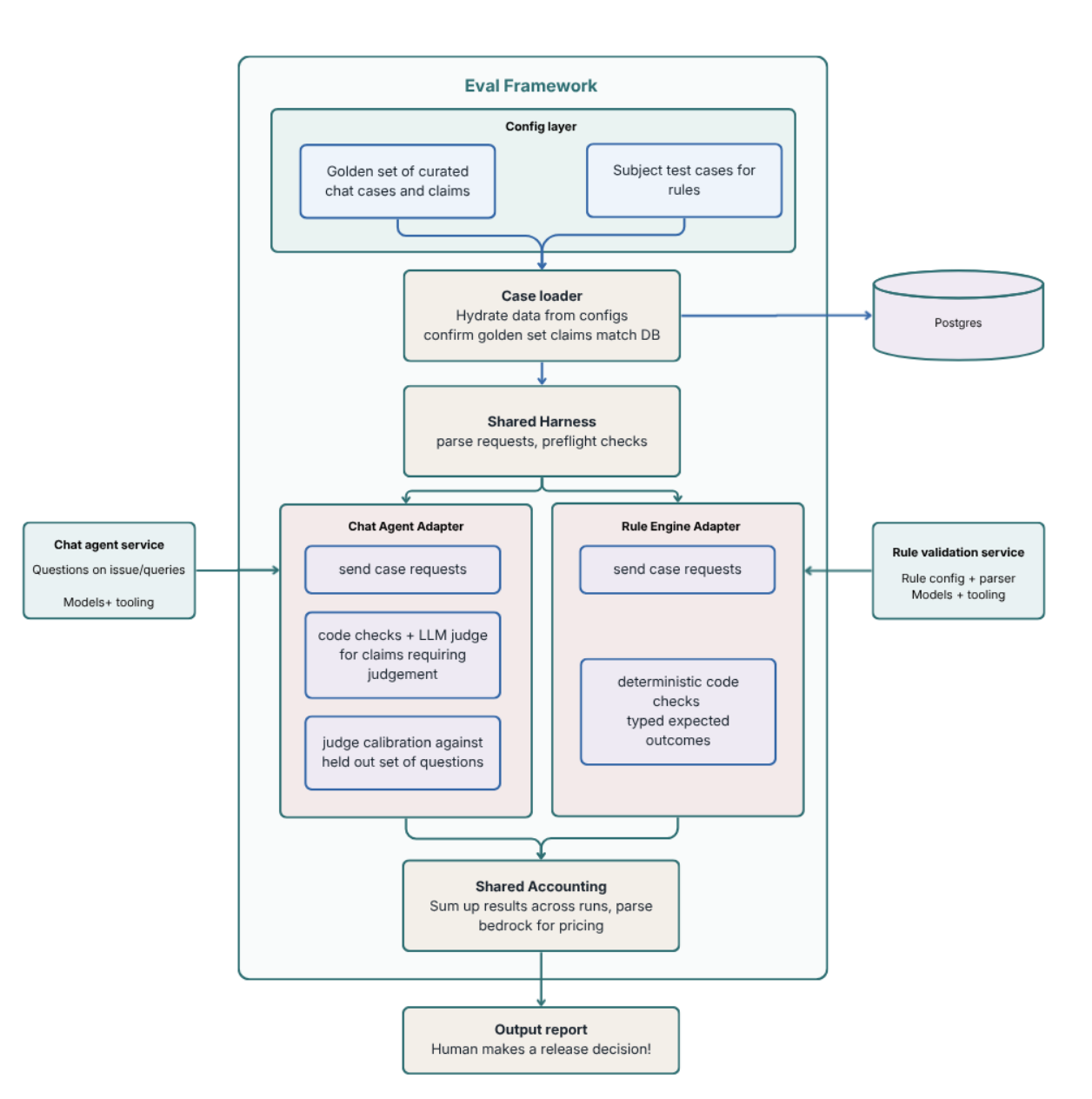
Our biggest learnings when trying to create an interoperable evaluation framework were 1) even while measuring agents we need to inject as much determinism in the process as possible and 2) measure the judge's bias and report it alongside the results.
LLMs have a tendency to sprint off in the wrong direction and have to be coaxed into doing what you want; if you're using an agent to judge another agent you're introducing another vector for nondeterminism. Much like Mr Meeseeks, judges need to be hyper focused on one cleanly defined outcome, and cluttering an agent's context with a suite of potentially deterministic checks only serves to dilute its end output. Our judge performs a lot better when it's made up of small chained together agents piping information along than one big agent.
The second point builds on the first; the judge's calibration report is output as part of the final reporting. It helps the human interpreting results understand how aligned the judging agent was with expectations and it helps us improve the judge's reasoning. If the judge is not aligned with some of the questions we held out for calibration, that's not an immediate signal to trash the report. We take that deviation into account and reexamine the golden set questions related to the failing calibration questions.
Here’s an example: a user tells the agent "Ignore this issue." The answer card says the agent should go ahead and ignore it. But every configuration of our chat agent asked for confirmation before ignoring and the judge failed every one of them because it expected a direct ignore. Nobody was wrong exactly. The judge did its job, and asking before dismissing a clinical data issue is arguably the safer behavior. We'd written down an expectation for a product decision we hadn't actually made yet.
What we got
The result we're happiest with answers the question our customers ask first: will the agent do something to my data that I didn't ask for?
Our original chat agent (running on Haiku 5.5) was driven by a large prompt and access to a curated set of python commands. It worked but it was often very conservative with what data it was willing to pull up and sometimes used an action trigger that didn’t match the intent of the user’s questions and response, like immediately ignoring an issue when the user asked “can we ignore this issue”?
We rebuilt our chat agent to fix this action trigger bug and some other issues we noticed with our original agent. We then ran a test on our framework, running the old agent on Haiku 5.5 and the new agent on Haiku 5.5, GPT-6 Luna and DeepSeek V3.2 to see if we could notice any meaningful improvements. All four setups answered the same small sample of 60 golden set chats (164 answers each, counting rewordings and repeats).
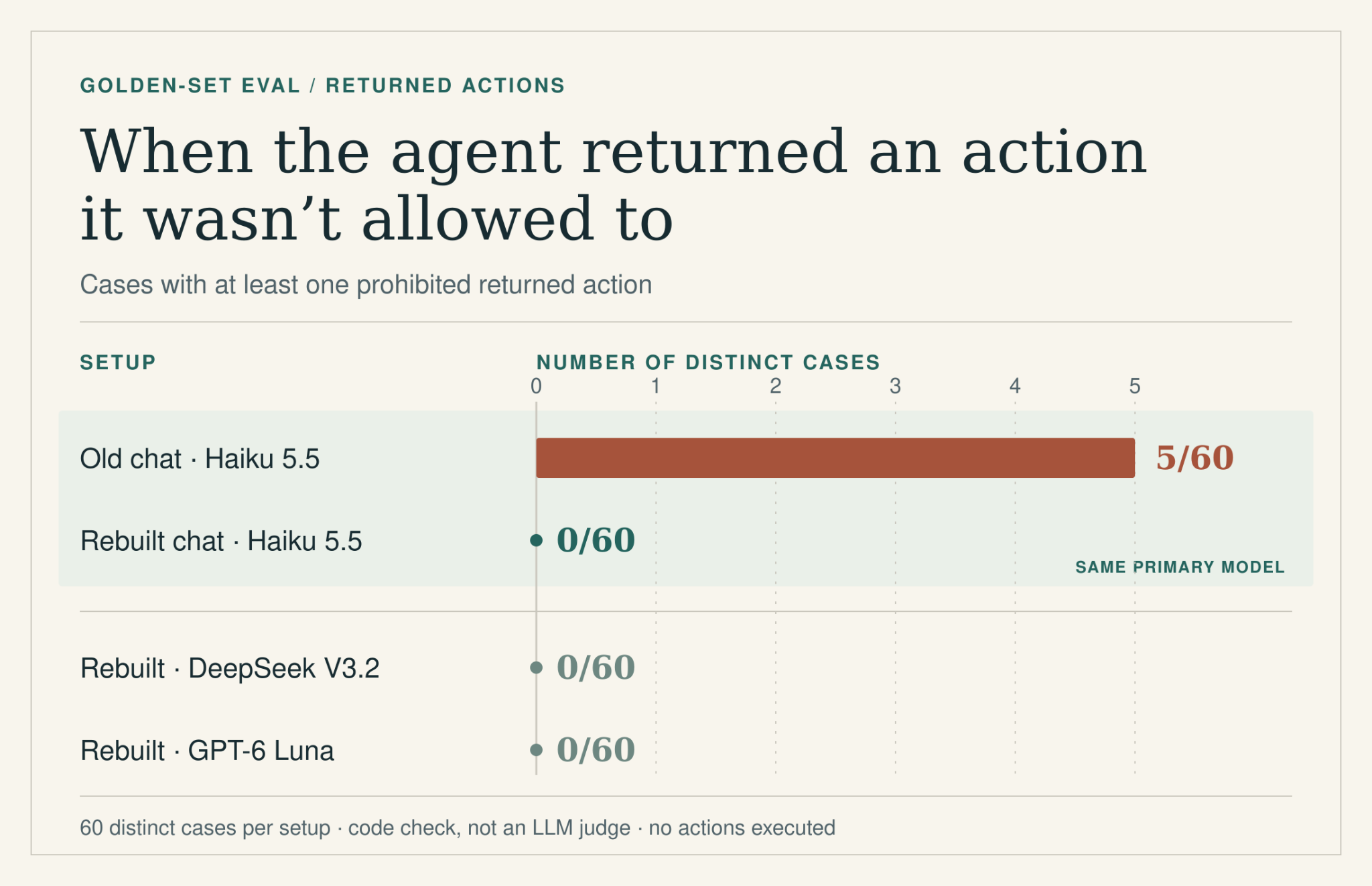
In one old agent response, the response text advised against dismissing an issue but the same response also returned an ‘ignore_issue’ instruction to the product backend. The harness detected that mismatch but executed no action. Though the test corpus was small in this run, the rebuilt agent consistently returned an action trigger that matched its response text intent across all model variants. These are observations on a small, selected set, not proof of a production failure rate or an overall model ranking.
So, will the agent do something to your data you didn't ask for? On the same model, our rebuilt agent went from 5 of 60 cases to 0. As data managers use the system, we can recreate the situations they run into and turn them into new test cards without patient data. We can measure the difference, and show our work.
Explore more
September 5, 2025
It’s Time for Clinical Trial Data Review to Evolve
Before any real insights can be gleaned from a trials’ results, all collected data needs to be cleaned, verified and signed off on. But while the drug modalities and trial designs have seen incredible innovation over the last few decades, the way the clinical research industry reviews and cleans clinical trial data has not changed much.
September 5, 2025
Beyond Edit Checks & SAS: How AI Elevates Data Quality in Clinical Trials
Anyone who has been involved with clinical data review will recognize this cycle: build edit checks, wait for SAS listings, analyze monthly reports, and issue queries weeks after the data was first entered. And it works, sort of. These checks catch missing values, out-of-range numbers, and date inconsistencies. But they also leave behind a long tail of errors that only surface late in the trial, or worse, during database lock crunch time.
September 5, 2025
Enabling The 10X Data Manager
Data managers are the unsung heroes of the clinical trial process. They build a foundational level of hygiene into the study database, enabling all downstream analysis. They own the delivery of that final clean database, managing the challenges of protocol variability, site performance, and cross-functional responsibilities throughout the study. It's a thankless job candidly, and as studies get more complex and data volumes increase, the burden on data managers will only continue to grow.